Product Manager Resume Signals: What Gets a “Yes” in 6 Seconds
What actually happens in those 6 seconds
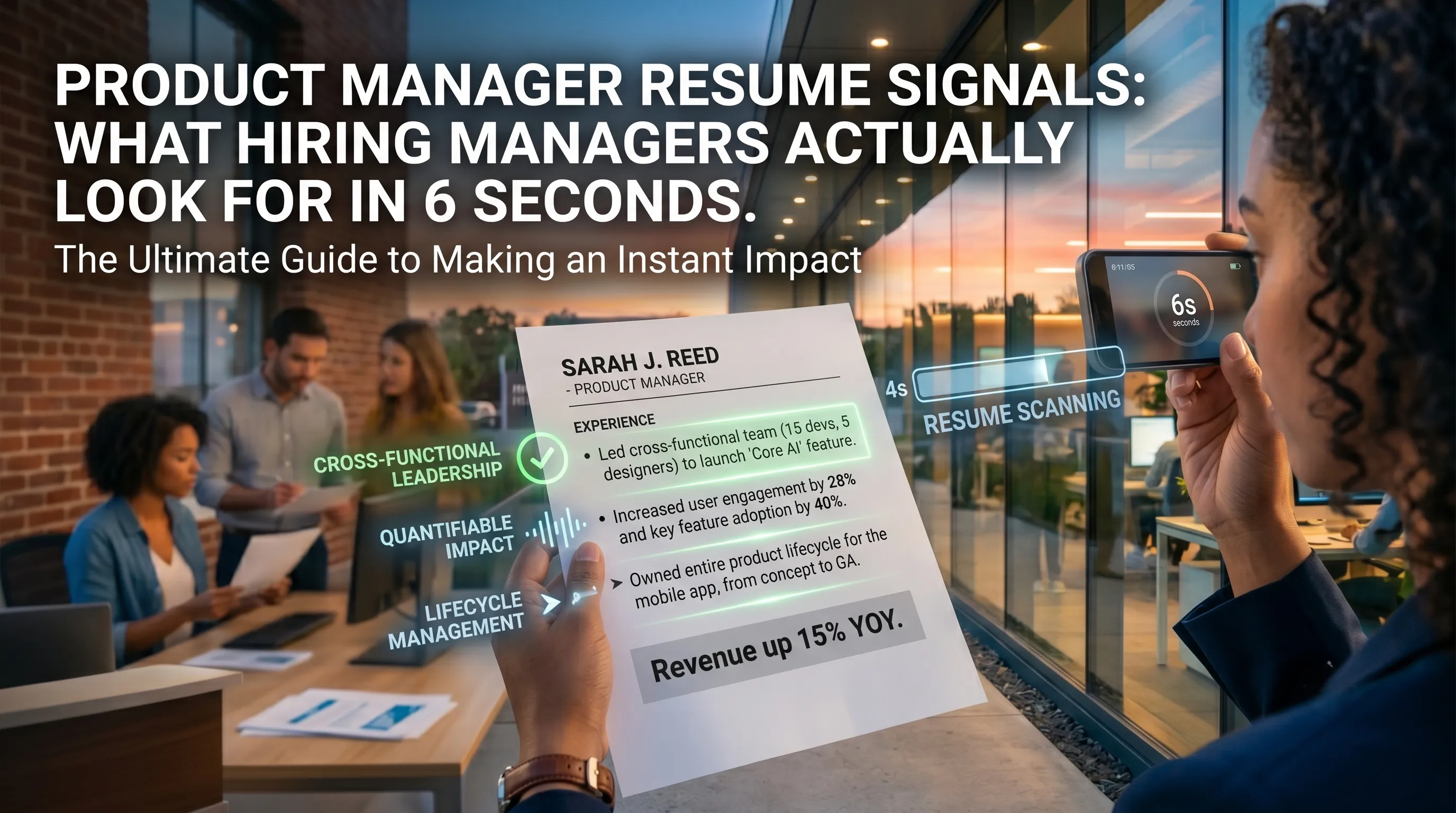
Eye‑tracking studies show recruiters spend their initial 6–7 seconds on a small set of data: your name, current and previous job titles, companies, dates, and education. For a PM role, they also scan for role alignment and visible impact before deciding if you’re worth a deeper read.
Think of that first pass as a binary check: “Does this look like a real product manager for this level and scope, or not?” If those basics don’t line up, no amount of beautifully written bullet points on page two will save you.
The core product signals they’re looking for
Multiple PM hiring guides and recruiters converge on three big signals in a resume:
- Product ownership and scope – Have you actually owned a product, a major area, or a critical metric, or were you just “supporting” others?
- Outcomes, not tasks – Can you show concrete changes in revenue, activation, retention, NPS, costs, or other key metrics—not just lists of features shipped?
- Cross‑functional leadership – Do you clearly lead work across engineering, design, data, marketing, and sales, or do you just “collaborate” in a vague way?
Many PM‑specific resources explicitly say that hiring managers are scanning for impact, leadership, and product thinking as the three core elements.
Designing the top third of the page
Formatting guides for PM resumes describe visual hierarchy like this: Who you are → What you’ve done → Why it matters. The top third of your resume should answer all three quickly.
Concrete layout that works well:
- Name + target title – “Senior Product Manager” or “Product Manager – Growth & Monetization,” not a generic “Professional.”
- Location + contact – City, email, LinkedIn; recruiters check location immediately in that first scan.
- 2–3 line summary – Mention domain (for example, B2B SaaS, marketplace, fintech), years of experience, and 1–2 signature strengths tied to outcomes.
- Key skills / domains – A compact skills row with relevant PM keywords (roadmapping, experimentation, SQL, user research) gives both ATS and humans quick alignment.
StellarPeers and other PM resources stress layout and contrast: recent PM experience and measurable outcomes belong above older roles or education for mid‑career candidates.
Writing bullets that sound like a PM, not a project coordinator
Most weak PM resumes describe responsibilities (“managed roadmap,” “worked with engineers”) instead of decisions and results. Hiring managers repeatedly say they want to see your judgment: which problems you chose, which bets you made, and what happened.
Example: weak vs strong product bullets
| Version | Bullet | Why it works (or doesn’t) |
|---|---|---|
| Weak | “Managed product backlog and coordinated with engineering and design teams.”linkedin+1 | Sounds like task management; no outcome, no scope, no metrics. |
| Strong | “Prioritized and managed a 60+ item backlog for a B2B analytics product, increasing weekly active users by 22% and reducing support tickets by 18% in 9 months.”redfishtech+2 | Shows scale, domain, ownership, and measurable business/user impact. |
| Weak | “Worked on onboarding flow for mobile app.” | No sense of objective or result. |
| Strong | “Redesigned mobile onboarding with design and data science, improving day‑7 activation from 41% to 57% through experiment‑driven iteration.”redfishtech+2 | Signals experimentation, collaboration, and clear product metrics. |
PM resume guides often recommend a simple pattern: Action → Method → Result, with a clear metric in each bullet.
Making keywords work for you (without stuffing)
Behind many product roles, there’s an ATS or internal filter checking for specific skills and tools. Recruiters advise you to pull key phrases from the job description (for example, “experimentation,” “A/B testing,” “roadmaps,” “stakeholder management,” “SQL,” “Figma,” “data‑driven decisions”) and weave them into your summary, skills row, and bullets where they’re genuinely true.
The goal is not to cram buzzwords into a separate block; it’s to make sure that when the system or the human asks, “Do I see evidence of experimentation / data / strategy / execution?” the answer is obviously yes.
The quick self‑check before you apply
Borrowing from recruiter advice on 6–7 second scans, you can do your own version:
-
Look at your resume for 6 seconds.
- Do you instantly see: PM title, level, domain, and your current/last company?
-
Skim your last two roles only.
- Can you spot at least 3 specific product outcomes (metrics, launches, experiments) without rereading?
-
Compare against the job description.
- Are the key responsibilities and tools reflected in your top third and in recent bullets, or only buried in older roles?
If the answer to any of those is “no,” the hiring manager’s answer is likely “pass.” If it’s “yes,” you have done what a good product does: made it easy for a very busy user to see the value quickly.